
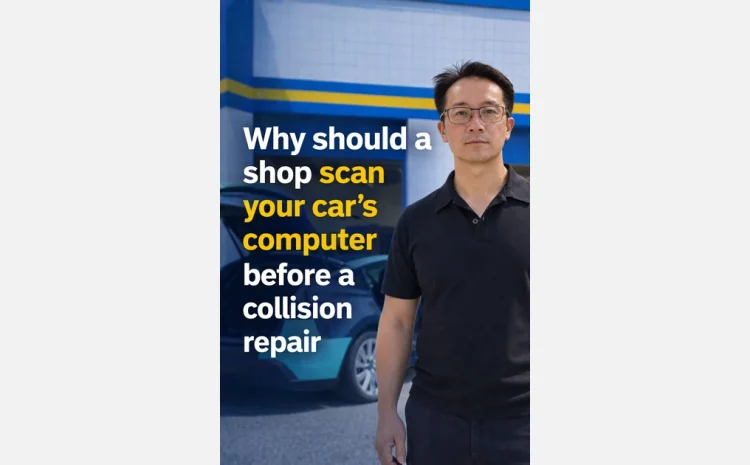
Why scan a car before collision repair?
Yes. A collision can affect electronic systems even when the dashboard stays quiet, so a visual inspection may not tell the whole story. In Richmond, a pre-repair diagnostic scan gives the repair discussion another source of information: stored diagnostic trouble codes can point to areas that deserve attention before tear down begins (ICBC).
Why can a visual inspection miss a problem?
A damaged bumper, panel or light may be easy to see, while an electronic fault may leave no obvious mark on the outside. The dashboard may also look normal. That does not prove that every system connected with the damaged area is operating as it should.
A scan uses a diagnostic tool to read codes stored by the vehicle. These codes can give the repair team an early indication that a system needs closer attention. The scan does not replace a careful physical inspection; it adds information that the eye cannot provide.
This matters before an estimate is finalized because hidden issues can change what the repair team needs to inspect. Finding a code early can make the discussion about the damage clearer before parts are removed or additional work is considered.
A vehicle might have bumper damage without displaying any warning symbol. A visual review may focus on the visible surface. A pre-repair diagnostic scan can add a check of stored electronic information, giving the repair conversation a wider starting point.
- A quiet dashboard does not answer every question about crash-related electronics.
- A stored code can identify a system that deserves further inspection.
- The scan is an information-gathering step, not a substitute for collision repair assessment.
What happens before the repair starts?
The shop connects a diagnostic tool to the vehicle and checks for stored trouble codes. The results can be recorded and discussed as part of the estimate review. This gives the vehicle owner a clearer way to ask what was checked before repair work begins.
ICBC’s scanning policy calls for a scan before tear down and another scan after repairs, with the purpose of helping identify and clear diagnostic trouble codes. The policy does not include advanced driver-assistance calibration (ICBC).
That distinction is useful. A scan reads diagnostic information, while calibration is a separate matter that may apply to driver-assistance equipment. If a vehicle has cameras, radar or other related equipment, ask how the repair plan addresses those systems instead of assuming a scan covers every procedure.
Suppose the estimate is approved before anyone checks stored codes. A code discovered later may require a new discussion about the scope of work. Reviewing scan information at the beginning can help separate issues that need attention from questions that still require physical inspection.
- The scan takes place before tear down in the ICBC scanning policy.
- The result can be reviewed alongside the visible damage and estimate.
- A scan should not be described as driver-assistance calibration.
How does the scan relate to manufacturer repair procedures?
Electronic information is only one part of a proper collision repair process. The repair plan also needs to consider the vehicle’s construction and the systems connected with the damaged area. A professional inspection is important when the damage involves structural panels, airbags or driver-assistance equipment.
ICBC’s program guide says participating shops must follow manufacturer repair procedures for structural panel repair or replacement and for parts associated with airbag and driver-assistance systems (ICBC).
That requirement helps explain why a scan should be discussed with the rest of the repair plan. The code report may show a system that needs attention, while the manufacturer’s procedures guide how the related repair should be carried out.
A scan cannot by itself confirm that a panel, restraint component or sensor is ready for use. It is better understood as an early diagnostic check that supports decisions about what should be inspected next.
For Richmond drivers comparing estimates, a useful question is whether the document identifies the pre-repair diagnostic scan and explains what its results mean. The answer can help show whether electronic concerns were considered before authorization.
- A diagnostic result does not replace manufacturer repair instructions.
- Structural, airbag and driver-assistance concerns need professional inspection.
- The estimate should make clear what the scan covers and what it does not cover.
What should you ask about the scan before approving work?
Start by asking whether a pre-repair diagnostic scan is included before tear down. Then ask whether the result will be available for review. These questions focus on the process rather than assuming that a lack of warning lights means there is nothing to check.
It is also reasonable to ask whether the shop plans a post-repair scan. Comparing information from before and after the work can help the repair discussion address diagnostic codes that were present at the start and those that remain afterward.
Ask what happens if the scan shows a code that is not clearly connected with the collision. Stored codes can relate to an earlier condition as well as the recent event, so the result needs context instead of an automatic conclusion.
Suppose the report shows a code that predates the collision. That does not automatically establish that the crash caused it. It does, however, give the owner and repair team a specific subject to discuss before the estimate or repair plan changes.
The most useful conversation is clear about limits. The scan can supply electronic information, but it cannot promise that every issue has been found, determine every cause, or take the place of a qualified inspection. Source details are current as of October 2026.
- Ask whether the scan occurs before tear down.
- Ask whether the report can be reviewed with the estimate.
- Ask how the shop separates pre-existing codes from collision-related concerns.
- Ask which separate procedures may be needed for driver-assistance systems.
Frequently asked questions
Why scan a car before collision repair?
Yes, a scan is useful because a vehicle may have stored diagnostic trouble codes even when no warning light is showing. It gives the repair discussion electronic information before collision work begins.
Does a pre-repair diagnostic scan replace a visual inspection?
No. The scan adds diagnostic information, but the vehicle still needs a professional physical inspection to assess visible, structural and safety-related damage.
Is a diagnostic scan the same as driver-assistance calibration?
No. A scan reads diagnostic information, while calibration is a separate procedure. The ICBC scanning policy does not include driver-assistance calibration (ICBC).
Can a stored code have existed before the collision?
It can. A code needs context, because the scan may identify an issue without proving when it began or what caused it.
What should be checked before approving collision repair?
Ask whether a pre-repair diagnostic scan is included, whether its report can be reviewed, and how the shop will address any codes or systems that need further inspection.
Read more about pre-repair diagnostic scan from Bridgeport Collision.
Questions about pre-repair diagnostic scan? Text 778-522-2188 or visit bridgeportcollision.com.
This article was written with AI. The video is presented by an AI avatar.